

How to Reduce Performance Anxiety and Feel More Confident

Do you ever wonder how to reduce performance anxiety? Does your heart pound or your mind go blank right before a big moment, whether it's in the boardroom, on stage, or in the bedroom? You're not alone, and the key isn't just to "calm down." It's about understanding what triggers your body's stress response, learning actionable techniques to manage it, and challenging the negative thoughts that fuel the fire.
This guide offers practical, helpful solutions to help you regain control. We'll walk you through cognitive strategies to master your mindset, physical techniques to calm your body, and long-term habits to build lasting resilience.
Understanding Why Performance Anxiety Happens
That feeling of your heart hammering against your ribs or your mind going blank is often called performance anxiety or stage fright. It’s your body’s ancient fight-or-flight system kicking into high gear. This isn’t a personal weakness; it’s a hardwired survival instinct that sees a high-pressure situation as a threat.
It doesn’t matter if that "threat" is a packed auditorium, a critical meeting, or an intimate moment. Your brain can interpret the pressure in the same way, flooding your system with adrenaline and causing very real, distracting physical symptoms.
At its core, performance anxiety often stems from a deep-seated fear of not measuring up, whether to your own standards or someone else's.
What Causes Performance Anxiety?
The primary driver is usually a powerful fear of failure. We worry about messing up, being judged, or failing to repeat a past success. This fear is often fed by a few common factors:
- Negative Past Experiences: One fumbled presentation or awkward moment can create a mental trap. Your brain remembers it and starts anticipating the same outcome every time.
- High-Stakes Situations: When the outcome feels incredibly important, like a championship game or a make-or-break pitch, the pressure cooker gets turned up.
- Unrealistic Expectations: Chasing perfection sets an impossibly high bar. This creates intense internal pressure that makes anxiety almost inevitable.
Realizing this is a shared human experience is the first step toward getting a handle on it. The World Health Organization reported that an estimated 301 million people were living with an anxiety disorder in 2019, showing just how common these feelings are. You can learn more about the global impact of anxiety disorders directly from their research.
Common Signs of Performance Anxiety
You can't fight what you can't see. Learning to recognize the early warning signs helps you get ahead of the anxiety spiral before it takes over.
By learning to identify these signs early, you can interrupt the anxiety cycle before it takes full control. This awareness transforms you from a passive victim of anxiety into an active manager of your own response.
Performance anxiety shows up in both your thoughts and your body, and they often feed each other. Here’s a quick breakdown of what to look for.
Common Signs of Performance Anxiety
This table gives you a quick snapshot of the mental and physical signals your body might be sending.
| Mental and Emotional Signs | Physical Signs |
|---|---|
| Racing thoughts and constant worry | Pounding or racing heart |
| Difficulty concentrating | Sweaty palms or cold hands |
| Intense self-consciousness | Shaking, trembling, or twitching |
| Deep fear of being judged negatively | A dry mouth or tight throat |
| Imagining the worst-case scenario | Nausea or "butterflies" in your stomach |
Once you understand why you're feeling this way, you can start to reframe it. Instead of interpreting a racing heart as a sign of failure, you can see it as your body getting amped up and ready for action.
Master Your Mindset with Cognitive Strategies
Performance anxiety often starts in your head, fueled by that nagging internal voice whispering doubts and worst-case scenarios. If you want to learn how to reduce performance anxiety, the real work begins with taming those thoughts.
This is more than just "positive thinking." It's about actively dismantling the specific thought patterns that trigger your anxiety and retraining your brain to respond to pressure with confidence, not panic.
Identify and Challenge Negative Thought Loops
Your first job is to become a detective of your own mind. The next time you feel anxious, pause and ask, "What story am I telling myself right now?" You'll likely find you’re trapped in a destructive thought loop.
These loops are common cognitive distortions—tricks your mind plays that warp reality. A few usual suspects include:
- Catastrophizing: Your mind leaps to the absolute worst possible outcome. "If this isn't perfect, my partner will think I'm a failure and leave."
- All-or-Nothing Thinking: Anything short of perfection is a complete disaster. "If I feel awkward for even a second, the whole night is ruined."
- Mind Reading: You assume you know what your partner is thinking, and you're certain it’s negative. "They're definitely noticing how nervous I am."
Once you've caught the thought, challenge it. Ask yourself, "Is this thought 100% true?" and "What's a more realistic way to look at this?" This simple act of questioning can break the spell.
A more balanced thought might sound like: "We're just two people exploring and connecting. It's not a performance. If something feels a little clumsy, we can laugh and move on. It’s about being together."
This isn't about ignoring problems. It's about grounding yourself in reality instead of letting fear write the script.
Use Visualization to Rehearse Success
Your brain has a hard time telling the difference between a real event and a vividly imagined one. You can use this to your advantage with a powerful technique called visualization. This isn't just wishful thinking—it's a structured mental rehearsal for success.
Don't just picture a vague, happy outcome. Walk yourself through the entire experience, step-by-step, from a place of calm and confidence.
Imagine exactly how you want to feel—relaxed, present, and connected. Picture yourself navigating any small interruptions with grace or humor. By mentally rehearsing not just the ideal scenario but also your confident response to imperfection, you create a mental blueprint for success.
Calm Your Body with Physical Techniques
When your heart is pounding and your palms are sweaty, anxiety can feel like a runaway train. While working on your mindset is key, sometimes the quickest way to get back in control is by tackling the physical symptoms head-on.
These techniques send a direct message to your brain that you're safe, helping you feel grounded and present. Forget vague advice like "just relax." These are practical exercises that work with your body to dial down that fight-or-flight response.
Activate Your Body’s Relaxation Response with Breathing
Your breath is a powerful and underrated tool for managing anxiety. When you get stressed, your breathing becomes shallow and quick, feeding the panic cycle. By consciously slowing your breathing, you can activate your parasympathetic nervous system—your body's built-in "rest and digest" mode.
One of the most effective methods is the 4-7-8 breathing technique. It's simple, discreet, and you can do it anywhere.
Here’s how it works:
- Inhale Quietly: Close your mouth and breathe in gently through your nose for a count of four.
- Hold Your Breath: Hold it for a count of seven.
- Exhale Completely: Breathe out completely through your mouth, making a soft "whoosh" sound, for a count of eight.
Repeat this cycle three or four times. You'll be surprised how quickly it can lower your heart rate and bring a sense of immediate calm.
Release Stored Tension with Progressive Muscle Relaxation
Anxiety doesn't just live in your head; it sets up camp in your body as a clenched jaw, tight shoulders, or a stomach in knots. Progressive Muscle Relaxation (PMR) is a practice designed to systematically release that tension.
The idea is straightforward: you intentionally tense a group of muscles for a few seconds and then let go, paying attention to the feeling of release.
By deliberately tensing and then relaxing your muscles, you become more aware of where you're holding stress. This awareness is the first step to consciously letting go of physical tension, which in turn helps soothe your mind.
You can start with your feet, tensing them for five seconds, then releasing. Slowly work your way up your body—legs, abdomen, arms, and all the way to your face.
Channel Nervous Energy with Mindful Movement
Ever felt so anxious you couldn't sit still? That's adrenaline, and it needs an outlet. Instead of fighting that jittery energy, a better approach is to channel it through mindful movement.
This could be a brisk five-minute walk, a few gentle stretches, or just shaking out your arms and legs. The goal is to get your body moving and blood flowing, which helps burn off excess cortisol and adrenaline.
In an intimate setting, this could even be part of a playful warm-up. Exploring what feels good for your body is a journey, and our guide on how to choose a vibrator can offer ideas for incorporating new sensations.
Visualization is another powerful tool, and the infographic below breaks down a simple, three-step process.
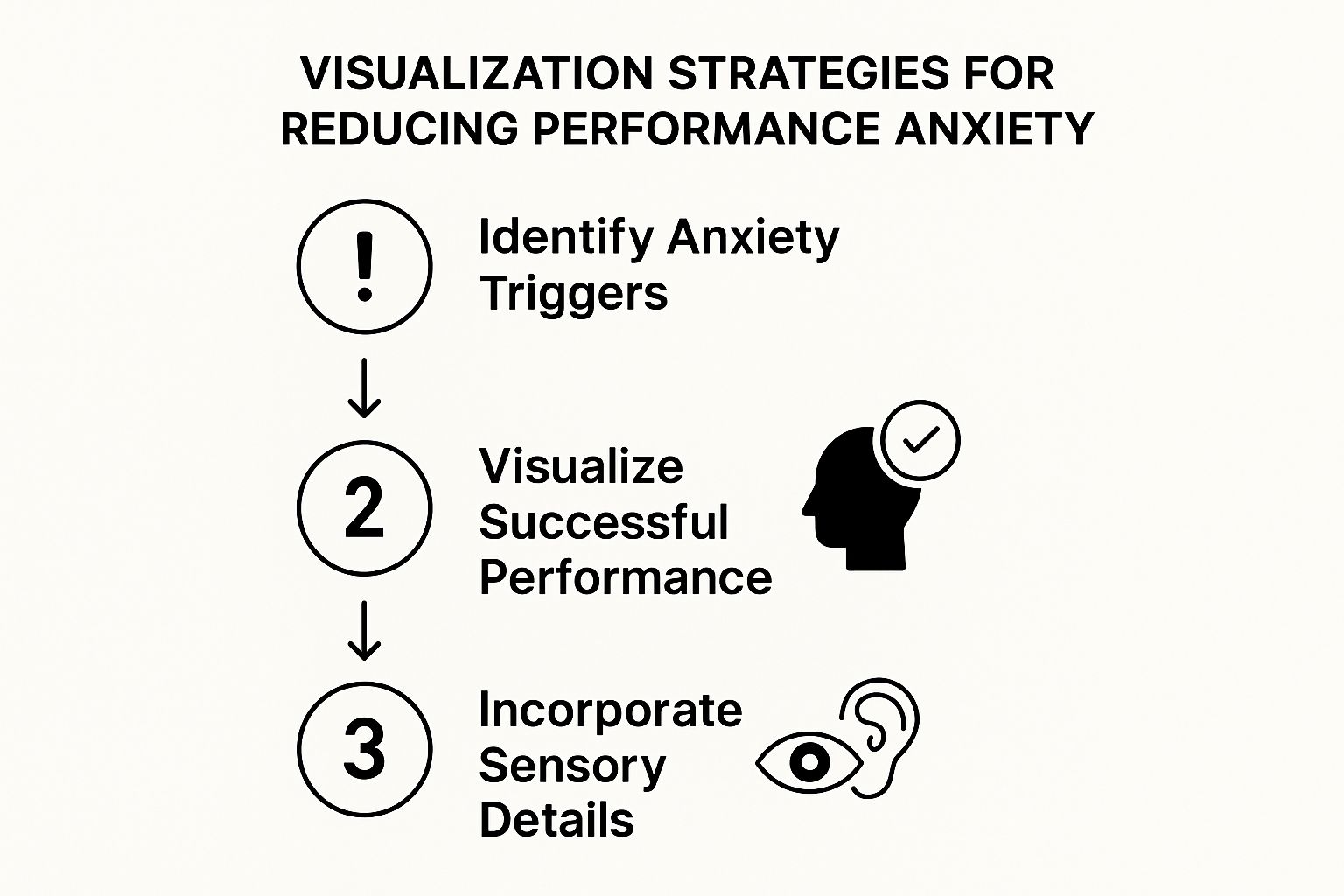
This process shows you how to identify triggers, visualize a successful outcome, and add sensory details to create a mental rehearsal that can calm performance anxiety.
Build Real Confidence Through Smart Preparation
One of the most effective ways to shut down the "what if" spiral that fuels anxiety is to build a foundation of genuine confidence. This isn't about faking it. It's about earning your confidence through smart, methodical preparation.
When you know you’ve done the work, you leave very little room for self-doubt to creep in. Feeling overwhelmed is a huge anxiety trigger, but breaking a big task down into small, manageable chunks makes the whole thing feel less intimidating.
Create a Plan of Action
A solid plan is a powerful antidote to anxiety because it eliminates guesswork and gives you a sense of control. Whether you're preparing for a presentation, an important conversation, or a date, knowing your next move helps quiet the mental chaos.
For instance, your plan could look like this:
- Brain Dump Every Task: Write down everything you need to do, no matter how small.
- Set Gentle Deadlines: Assign a realistic deadline to each item to create structure, not pressure.
- Gather Your Tools: Figure out everything you'll need ahead of time, from presentation notes to the outfit that makes you feel most confident.
This approach turns a massive event into a checklist of small, achievable wins. Every task you cross off builds your confidence.
Rehearse for Real-World Scenarios
Practice is crucial, but not all practice is created equal. Effective rehearsal means simulating the actual performance environment as closely as you can. This helps desensitize your nervous system to the pressure.
If you’re anxious about a presentation, practice in an empty conference room, not just at your desk. If you're nervous about a social situation, try a low-stakes version first with a friend.
This kind of practice helps your brain categorize the real situation as familiar and non-threatening.
The point of rehearsal isn't perfection. It's about building familiarity and muscle memory, so when the nerves kick in, your preparation can carry you through.
High-stakes environments are a natural breeding ground for stress. Studies on medical students, for example, show a global anxiety prevalence of 33.8%—far higher than the general population. This underscores how critical preparation is for anyone facing a demanding situation. You can read more about the findings on performance pressure to see how this applies across different fields.
Take Care of the Logistics
Finally, never underestimate the power of sorting out the little things. Knowing you have the logistics handled frees up mental energy that you can then focus on your performance.
This means getting a good night's sleep, eating a meal that won't upset your stomach, and double-checking your travel time. When these basic needs are covered, you create a stable foundation that helps you feel grounded and ready.
Develop Long-Term Resilience to Pressure
While in-the-moment tricks are great for immediate relief, the real goal is to build lasting resilience. Learning how to reduce performance anxiety for good means weaving sustainable habits into your daily life. These long-term strategies work behind the scenes to lower your baseline anxiety, making you less susceptible to pressure.
Think of it like building a strong foundation for a house. By focusing on these fundamental wellness pillars, you create a more stable internal environment that’s better equipped to handle stress.
Fuel Your Body and Mind
What you eat, how you move, and how well you sleep have a direct and powerful impact on your body’s stress-response system. These are essential tools for regulating your mood and keeping anxiety in check.
- Consistent Exercise: Regular movement is one of the most effective anxiety-busters. It helps burn off excess cortisol (the stress hormone) and releases endorphins, your brain's natural mood elevators.
- Nutrient-Rich Diet: The gut-brain connection is real. A diet heavy on processed foods can contribute to feelings of agitation, while a balanced diet rich in whole foods gives your mind the fuel it needs.
- Solid Sleep Hygiene: A lack of quality sleep can amplify anxiety. Prioritizing 7-8 hours of sleep a night helps regulate the hormones that control stress and mood.
These elements create a powerful buffer against anxiety. Recent analysis showed a staggering 52% increase in new anxiety disorder cases among young adults over the past three decades, highlighting why building this resilience is so critical. You can read the full research about these trends.
Cultivate a Mindful Presence
Mindfulness isn't about emptying your mind. It’s about learning to observe your thoughts without getting swept away by them. A regular mindfulness or meditation practice teaches you to create a small but powerful gap between a thought and your reaction.
By consistently practicing mindfulness, you train your brain to notice anxious thoughts as they arise without immediately buying into their narrative. You learn to see them as mental noise, not undeniable truths.
This practice builds a kind of mental muscle. Over time, you become less reactive to your internal chatter and can gently bring your focus back to the present moment.
Focusing on sensation can also be a powerful anchor. Our guide on the sexual health benefits of using sex toys discusses how focusing on physical pleasure can deepen this mind-body connection.
Practice Radical Self-Compassion
A critical piece of the resilience puzzle is how you talk to yourself after a perceived setback. Many of us who struggle with performance anxiety are also harsh self-critics. One mistake can trigger an avalanche of negative self-talk that deepens the fear for next time.
Self-compassion is the antidote. It means treating yourself with the same kindness you would offer a good friend who is struggling. Acknowledge that things don't always go perfectly and that a misstep doesn't define your worth. This shift transforms setbacks from failures into learning opportunities.
Your Questions About Performance Anxiety, Answered
As you start putting these strategies into practice, you're bound to have some questions. Let's tackle some of the most common ones so you can move forward with more clarity and confidence.
How Long Does It Take for These Techniques to Work?
The honest answer is: it varies. Some tools give you a quick win. The 4-7-8 breathing technique, for instance, can bring you back from the edge in seconds by calming your nervous system right when you need it most.
Mental strategies, on the other hand, are a long game. Rerouting negative thought patterns is like building a new muscle—it takes consistent practice. You'll likely notice a real difference after a few weeks of dedicated effort, while lifestyle changes will lower your overall anxiety over months.
Can I Get Rid of Performance Anxiety for Good?
The goal isn't to erase anxiety from your life completely. A little bit of nervous energy can actually sharpen your focus. The real aim is to dial it down from a roar to a whisper, so it no longer hijacks the moment.
With consistent practice, you can transform that debilitating fear into a manageable—and sometimes even helpful—buzz of energy. It’s all about making that feeling work for you, not against you.
What if My Anxiety Is Specifically About Sex?
You are not alone. Sexual performance anxiety is incredibly common and responds well to these same principles. The biggest breakthrough often comes from shifting your focus from "performance" to connection and shared pleasure.
Here’s what really helps:
- Talk about it. Open, honest communication with your partner can instantly diffuse the pressure.
- Stay present. Mindfulness helps you stay grounded in your body, not stuck in your head.
- Relax your body. All the physical relaxation techniques we covered are just as effective here.
Exploring pleasure in a new, low-stakes way can also make a huge difference. If you're curious, our guide on sex toy shopping for beginners is a fantastic starting point.
When Should I Talk to a Professional?
If you feel like performance anxiety is constantly sabotaging your career, relationships, or general happiness, seeking professional help is a sign of strength. It's a smart, proactive move.
A therapist, especially one who specializes in Cognitive Behavioral Therapy (CBT), can give you a roadmap tailored to you. They'll help you get to the root of the anxiety and build a personalized toolkit to manage it.
Reaching out for support is never a sign of weakness. It's a sign of strength and a clear commitment to your well-being, giving you the specialized tools needed to regain control and thrive.
At My Luxury Toys, we believe that confidence and pleasure go hand in hand. Explore our curated collections to discover new ways to connect with yourself and your partner, free from pressure. Shop now at myluxurytoys.com.