

How to Overcome Sexual Anxiety and Boost Your Confidence

Are you feeling stressed or worried when you think about sex? Do you find yourself caught in a loop of "what ifs" that makes it hard to be present with your partner? If so, you're not alone, and what you're feeling is often called sexual anxiety. It's a common experience that can stem from body image concerns, performance pressure, or past experiences.
The good news is that you can absolutely learn how to manage these feelings. The first step is to get curious about where your anxiety is coming from—without any judgment. Let's be clear: these feelings are a completely normal response to a blend of psychological, emotional, and even societal pressures. They are not a sign of some personal flaw.
Understand What’s Fueling Your Anxiety to Overcome It
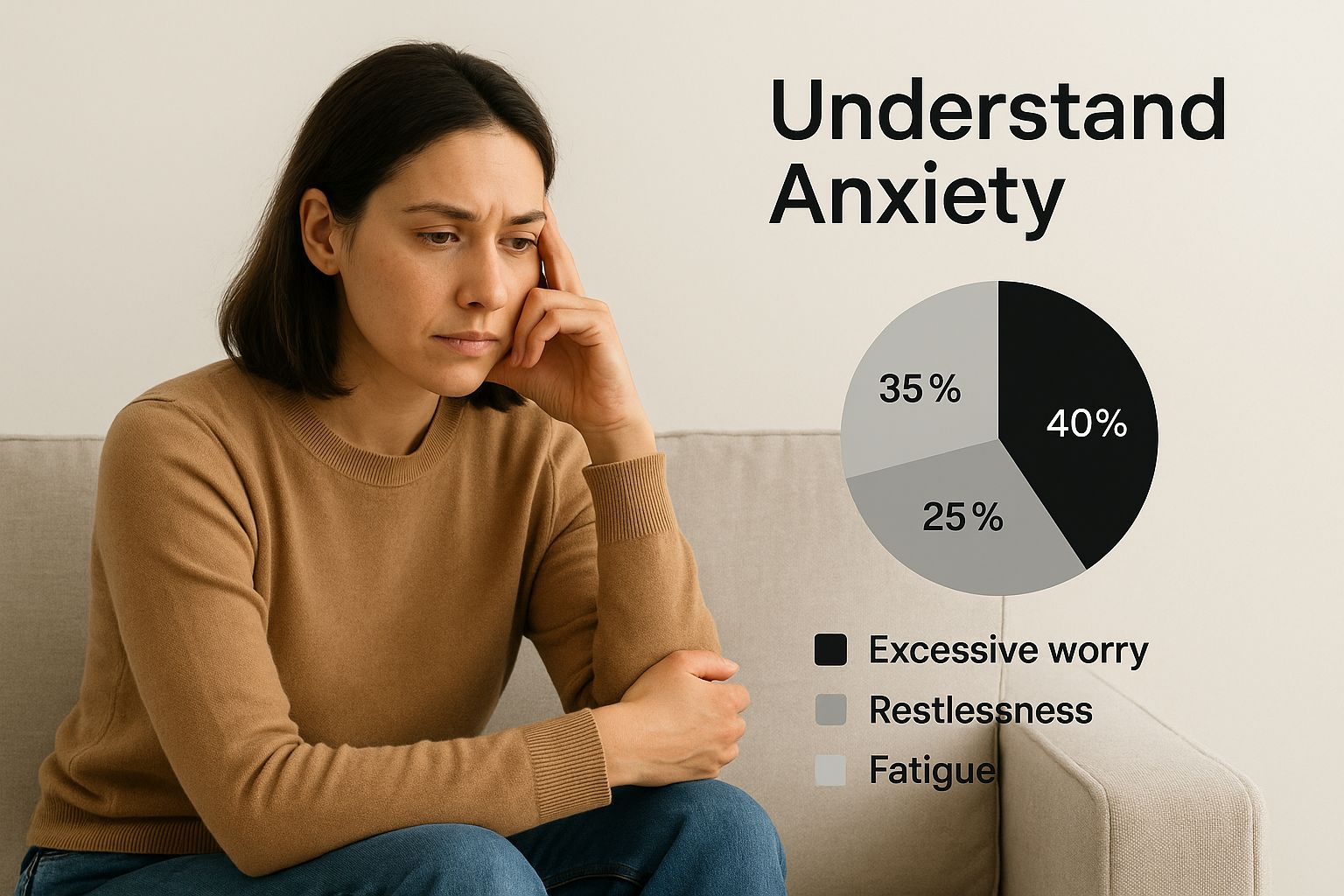
To start overcoming sexual anxiety, it's essential to understand what's causing it. Exploring the "why" behind your anxiety is the essential groundwork for managing it. When you understand the source, you can start to address it directly instead of just fighting the symptoms.
Sexual anxiety can feel incredibly isolating, but it's a shared experience. It touches people of every gender, orientation, and walk of life. This isn't just about "performance"—it’s a tangled web of thoughts and feelings that can turn what should be a moment of connection into a major source of stress.
So, the very first step in learning how to overcome sexual anxiety is to figure out what's feeding it. Think of it like a detective investigating a case. You need to gather clues and identify the suspects before you can solve the mystery.
Getting to Know Your Triggers
So, what are these triggers? They’re different for everyone, but they often fall into a few common categories. Pinpointing which ones resonate with you is the key to finding strategies that actually work.
A lot of different things can stir up these feelings. Here's a quick look at some of the most common culprits, which might help you start connecting the dots for yourself.
Common Triggers of Sexual Anxiety
| Trigger Type | Specific Examples |
|---|---|
| Past Experiences | A bad breakup, a critical comment from a past partner, or any form of sexual trauma can leave deep emotional scars that surface during intimacy. |
| Body Image Issues | Constantly worrying about how your body looks—whether it's your weight, a scar, or anything else—makes it nearly impossible to relax and enjoy the moment. |
| Relationship Dynamics | Unspoken resentment, a lack of emotional intimacy, or poor communication with your partner can easily manifest as anxiety in the bedroom. |
| Societal Pressure | Media, porn, and even conversations with friends can create unrealistic expectations about what sex "should" be, leading to feelings of inadequacy. |
| Performance Worries | The classic fear of not being able to "perform"—whether it's getting an erection, lasting long enough, or pleasing a partner—can become a self-fulfilling prophecy. |
Seeing your triggers laid out like this can be a huge relief. It helps you realize these anxieties aren’t just random; they have real, understandable origins.
Remember, anxiety itself is a universal human experience. In fact, anxiety disorders are one of the most common mental health challenges worldwide. The World Health Organization reported that back in 2019, an estimated 301 million people were living with an anxiety disorder. Sexual anxiety is often just one specific way these broader patterns show up in our lives.
The goal isn't to eliminate every anxious thought. It's to learn how to acknowledge those thoughts without letting them control the experience. Self-compassion is your most powerful tool here.
Once you start seeing that these feelings have logical, identifiable sources, they stop feeling like insurmountable personal failings. Instead, they become manageable challenges. This mindset shift is everything, and it's the foundation for every other technique you'll learn.
You're not broken. You're human. And acknowledging that is the real first step toward reclaiming intimacy, pleasure, and connection.
Shifting Your Mindset to Reduce Performance Pressure
A huge part of figuring out how to overcome sexual anxiety is learning to quiet that intense pressure to perform perfectly. You know the script—that inner voice whispering, "What if I can't?" or "What will they think of me?" It can turn what should be a shared, intimate connection into a high-stakes audition.
The good news? You can completely rewrite that script. With a few simple mindset shifts, many of which are inspired by Cognitive Behavioral Therapy (CBT), you can start to question and reframe those automatic negative thoughts. It’s all about making a conscious choice to focus on connection and pleasure, not some rigid, often unrealistic, outcome.
The whole process starts with a simple realization: your thoughts are not facts. Just because a worry pops into your head doesn’t mean it’s true, and it certainly doesn't have to define your reality.
Challenge Your Automatic Thoughts
When anxiety starts to bubble up, your mind is probably running on what experts call cognitive distortions. These are just unhelpful, often wildly exaggerated thought patterns that feed the anxiety loop. The first step to disarming them is simply learning to spot them.
For example, you might be "mind-reading" by assuming you know your partner is judging you. Or maybe you're "catastrophizing," convinced that one slightly awkward moment will torpedo the entire experience and maybe even your relationship.
Here’s a practical way to fight back:
- Catch the Thought: First, just notice the specific anxious thought. Something like, “If I don’t get an erection immediately, they'll think I’m not attracted to them.”
- Question It: Now, push back a little. Ask yourself, "Is there any real evidence for this? Is there any other way to look at this situation?"
- Reframe It: Finally, replace it with something more balanced and kind. Try this: “My partner cares about me and our connection, not just my body's immediate response. We have plenty of ways to be intimate and share pleasure.”
Doing this consistently, even when it feels a bit strange at first, literally retrains your brain to stop jumping to the worst-case scenario. We dive deeper into these kinds of strategies in our guide on how to reduce performance anxiety, which is packed with more practical tips.
Redefine What Success Means
Let's be honest, sexual anxiety loves a narrow, goal-oriented definition of sex. When the entire experience is judged solely on orgasm or "perfect" performance, anything short of that feels like a failure. That's a surefire recipe for stress.
The most powerful shift you can make is to redefine "good sex" as an experience of mutual pleasure, connection, and presence—not a performance that needs a five-star review.
Instead of aiming for a specific destination, try focusing on the journey itself. What does it feel like to be touched? What does your partner's breathing sound like? Pulling your focus back to the senses is a core principle of mindfulness, and it works wonders here.
Embrace Imperfection and Vulnerability
Perfectionism is the absolute enemy of intimacy. Real, authentic connection blossoms when we allow ourselves to be human—vulnerable and wonderfully imperfect. Let's face it, sex can sometimes be awkward, clumsy, or even hilarious. That’s not a failure; it’s just real life.
Giving yourself permission to not be perfect instantly lowers the stakes. It creates room for genuine interaction, where you and your partner are a team figuring things out together. That kind of shared vulnerability will always create a deeper, more lasting intimacy than a flawless "performance" ever could.
Using Communication to Build Intimacy and Trust
Sexual anxiety absolutely thrives in silence. When you keep your fears locked up, they have a nasty habit of growing into huge, intimidating monsters in your mind, making you feel completely isolated. The good news is that open, honest communication can be the perfect antidote. It has the power to transform your partner from a source of pressure into your greatest ally.
Of course, talking about something this personal can feel terrifying. The trick is to start the conversation completely outside of the bedroom. Find a neutral, relaxed moment—maybe over coffee on a Sunday morning or while you’re out for a walk—where neither of you feels put on the spot.
Remember, this isn't about pointing fingers or assigning blame. It's about inviting your partner into your world so you can start working as a team.
Starting the Conversation
Figuring out how to overcome sexual anxiety almost always starts with one courageous conversation. You don't need to have the perfect words all planned out; you just need an honest place to begin. The whole point is to share what you're going through without making your partner feel like they're the cause of the problem.
A great way to do this is by using "I" statements, which keep the focus on your own feelings. For example, instead of saying, "You make me feel pressured," which immediately puts someone on the defensive, you could try, "Lately, I've been feeling a lot of anxiety around intimacy, and it’s making it really hard for me to relax and just be present with you."
See the difference? One is an accusation, the other is an invitation to understand.
Here are a few other gentle ways to open the door:
- "Can we talk about something that's been on my mind? I've been struggling with some anxiety around sex, and I'd love for us to be on the same team with it."
- "I feel so close to you in so many ways, but sometimes my own head gets in the way during intimate moments. I want to share a little about what that’s like for me."
- "I really want to feel more connected with you, but my anxiety has become a real barrier. I was hoping we could explore some ways to take the pressure off for a while?"
Opening up like this is a massive trust-builder. When your partner gets a glimpse of what's actually happening inside your head, they’re far less likely to misinterpret your distance or hesitation as a rejection of them.
What to Share with Your Partner
Once you've started the conversation, try to be specific about what you're experiencing and what might actually help. Vague comments can leave your partner feeling lost, but clear examples give them a real roadmap to support you. Talk about your triggers, the kind of thoughts that spiral in your mind, and even the physical sensations you feel.
For instance, you could say, "Sometimes when we start to get intimate, my mind just starts racing with worries about whether I'll be able to perform or if I'm going to disappoint you. It has nothing to do with you—it’s just this automatic fear response that kicks in." This helps them understand it's not personal.
By sharing your internal experience, you're not just offloading a burden—you're building a bridge. It allows your partner to meet you with empathy instead of confusion, strengthening your emotional bond and making intimacy feel safer.
Mindfulness and Body-Based Techniques to Stay Present

So much of sexual anxiety lives in your head. It's that running commentary, the constant stream of "what ifs" and worst-case scenarios that pulls you out of the moment. When your mind is racing, your body instinctively tenses up, making it almost impossible to actually feel anything pleasurable.
This is exactly why bringing your focus back to your body is so critical. Think of mindfulness and body-based practices as your anchor. They gently guide you out of the mental chaos and back into your physical self, grounding you in what’s happening right here, right now. The whole point is to reteach your nervous system that intimacy can be a source of relaxation and connection, not just another reason to feel on edge.
Simple Breathing Exercises to Calm Your Nervous System
One of the quickest ways to hit the brakes on an anxiety spiral is by changing your breath. When you get anxious, your breathing gets fast and shallow, which just screams "DANGER!" to your brain. By deliberately slowing your breath down, you send a powerful message back to your brain that everything is okay.
You can do this for a few minutes before being intimate to get into a calmer headspace, or even in the middle of a moment if you feel your thoughts starting to drift toward worry.
- Box Breathing: This one is a classic for a reason—it works. Simply inhale for a count of four, hold for four, exhale for four, and hold again for four. Just a few rounds of this can make a noticeable difference.
- 4-7-8 Breathing: A slightly different pattern, but incredibly effective for deep relaxation. Breathe in through your nose for four seconds. Hold that breath for seven seconds. Then, exhale slowly and completely through your mouth (making a "whoosh" sound) for eight seconds.
Reconnecting Through Sensate Focus
If you're dealing with performance-related anxiety, an exercise called sensate focus can be a total game-changer. Developed by sex therapy pioneers, its genius lies in taking all goals and expectations off the table. The focus shifts entirely from performance to simply feeling.
It's a step-by-step practice where you and your partner take turns touching and being touched, without any pressure for it to lead anywhere.
The only rule of sensate focus is to pay attention to the physical sensations. What does the touch feel like? Is it warm? Is the pressure light or firm? Your only job is to notice and communicate.
You start with non-sexual touch—think back, arms, legs, even feet. This immediately lowers the stakes and gives your nervous system a chance to relax into the experience of being touched. Over time, as you both get more comfortable, you can slowly re-introduce more intimate touch. The process fundamentally helps you rewire the connection between touch and pleasure, replacing fear with curiosity.
It's also worth noting that anxiety doesn't always show up the same way for everyone. For instance, data from the National Comorbidity Survey in the U.S. revealed that lifetime anxiety disorder rates were quite different between genders. If you're interested, you can read more about how gender influences anxiety rates from this in-depth study.
Rebuilding Confidence by Exploring Pleasure on Your Own
One of the most powerful things you can do to tackle sexual anxiety is to rebuild your confidence from the ground up—on your own terms. Solo exploration offers a safe, pressure-free way to reconnect with your body and rediscover what feels good to you, far from the expectations of a partner.
This isn't just about masturbation; it's about reclaiming pleasure for yourself. It helps dismantle the toxic idea that sex is a performance for someone else's benefit. When you genuinely know what you enjoy, you can communicate it more effectively and walk into partnered experiences feeling much more sure of yourself.
Creating Your Own Safe Space
First things first: you need to create an environment where you feel completely relaxed and secure. This isn’t a race to the finish line. It’s about setting the stage for curiosity and gentle, unhurried exploration.
This means finding a time and place where you absolutely will not be interrupted. For you, that might mean lighting a candle, putting on a playlist that gets you in the right headspace, or just making sure the door is locked. A calm setting can help quiet those anxious voices in your head.
The whole point of solo exploration is discovery, not performance. Give yourself permission to be curious, to go slow, and to focus entirely on what your body is feeling, without any agenda whatsoever.
Focusing on Sensory Experience
Once you’re comfortable, gently shift your focus away from your racing thoughts and into your body. Instead of getting caught up in what should be happening, just pay attention to the actual sensations of touch.
- Start with Non-Genital Touch: Begin by exploring touch on other parts of your body. Notice how lotion feels on your skin, the warmth of a blanket, or the simple sensation of your own hands on your arms and legs.
- Explore Different Textures and Pressures: Use your hands, a piece of soft fabric, or even a personal massager to experiment with what feels good. Is it light, feathery strokes, or something more firm and steady?
- Introduce Pleasure Products: High-quality sex toys can be fantastic tools for self-discovery, helping you explore sensations you might not achieve with your hands alone. Learning about the sexual health benefits of using sex toys is a great place to start.
Ultimately, this practice is a profound act of self-care and empowerment. It helps you draw a detailed map of your own pleasure, giving you a powerful sense of agency that you can carry into any future intimate encounter.
When It's Time to Get Professional Support for Sexual Anxiety
While the self-help strategies we've covered are incredibly effective, there are times when the bravest and most powerful thing you can do is reach out for professional help. Recognizing when you need that extra guidance isn't a sign of weakness—it's a sign of strength.
If your anxiety feels like it's sticking around, becoming overwhelming, or genuinely getting in the way of your happiness and relationships, it's probably time to talk to a professional.
Think about it like this: if your car started making a weird noise you couldn't diagnose, you'd take it to a mechanic, right? Your mental and sexual health deserve that same level of expert attention. A good therapist can offer a safe, completely confidential space to dig into where this anxiety is coming from and build a plan that's just for you.
Finding the Right Professional for You
Diving into the world of therapy can feel a little intimidating, but knowing who does what makes it a lot easier. A certified sex therapist is someone with specialized training to tackle sexual concerns head-on. On the other hand, a psychologist or licensed counselor can be fantastic for working through underlying issues like general anxiety, depression, or past trauma.
When you're vetting potential therapists, it's totally okay to interview them. A quick consultation call can tell you a lot.
Here are a few questions you might want to ask to see if it's a good fit:
- Have you worked with clients dealing with sexual anxiety before?
- What's your general approach? (e.g., Cognitive Behavioral Therapy, mindfulness)
- How do you work with clients to set goals and track progress?
It's also crucial to find someone who understands your life and background—what therapists call "culturally competent care." Some groups face higher rates of anxiety due to social stigma and minority stress. For example, some studies have shown higher anxiety prevalence among men who have sex with men (MSM), which really underscores why finding a professional who gets these unique challenges is so important. If you're interested in the data, you can read more about it in this in-depth research on anxiety in key populations.
Seeking therapy isn't admitting defeat. It's making a proactive investment in your own happiness and taking a stand for the joyful, fulfilling intimate life you deserve.
At the end of the day, finding the right therapist comes down to feeling a real sense of connection and trust. Professional support can give you the tools and the fresh perspective you need to finally move past sexual anxiety. Building this foundation of trust is key in all areas of intimacy, which is why we also put together a guide on essential safety tips for couples toys to help you explore with confidence.
Got Questions About Sexual Anxiety? We've Got Answers.
When you're dealing with something as personal as sexual anxiety, it’s only natural to have a lot of questions pop up. Let's tackle a couple of the most common ones we hear.
How Long Until I Start Feeling Better?
This is the big question, isn't it? The honest answer is: it’s different for everyone. Some people start to feel a real shift in just a few weeks, especially if they dive into mindfulness exercises and really commit to better communication.
For others, it might be a longer road, particularly if the anxiety is tied to past trauma or deep-seated insecurities. The most important thing is to focus on consistency, not speed. Small, consistent efforts are what build lasting confidence and peace of mind.
What if My Partner Just Doesn't Get It?
This is a really tough spot to be in, and your feelings are completely valid. If you've laid your heart out and your partner is still unsupportive or dismissive, it might be time to focus on your own well-being first.
Seeking support from a therapist on your own can be incredibly empowering. They can give you the tools to build your own confidence and coping skills, which is valuable no matter how your partner is reacting.
At My Luxury Toys, we’re firm believers that everyone deserves to feel confident, connected, and full of pleasure. Taking the time to explore what feels good to you is a huge step on that path. Our collections are carefully chosen to help you discover your own unique journey to sexual wellness.
Explore Our Collections at My Luxury Toys